Finfluencers in Switzerland - Between financial education, reach and strategic added value
Finfluencers are increasingly shaping how financial topics are perceived and understood in Switzerland. Between financial education, reach and monetisation, an ecosystem has developed that is relevant for financial institutions in terms of communication. However, it requires clear classification, transparency and strategic clarity.
Financial topics are increasingly being consumed via social media. These channels are used in particular by younger target groups, newcomers and small investors, for whom traditional access via banks or financial advisors is often unavailable or seems too complicated. Social media platforms such as Instagram, TikTok, YouTube and LinkedIn are the first point of contact with the topic of investing for many people.
Traditional financial communication often requires a certain amount of knowledge: product information, fact sheets and regulatory notices are accurate and necessary, but often seem complex and inaccessible to these target groups. Finfluencers, as well as financial education platforms, fill an important gap here: they explain the basics, contextualise developments and lower the barriers to entry. In doing so, they are now making a relevant contribution to financial education in Switzerland.
This development is also changing the communication context for financial institutions. The view of finfluencers should therefore be less influenced by short-term marketing considerations and more by the question of what role these players can actually play in the Swiss financial ecosystem.
A fragmented market with limited reach
The number of profiles, accounts and formats in the Swiss market is growing steadily. At the same time, the effective reach of individual players remains limited compared to international standards. In addition to individual profiles with a wide reach, there are specialised niche accounts, platforms with a strong focus on education and community, but also numerous "me too" profiles.
Successful finfluencer profiles usually have clear thematic focuses, recognisable formats, a consistent tone and an authentic attitude. Those who try to cover all financial topics equally or opportunistically adapt to trends quickly lose credibility.
Who sets the tone and why simple formats work
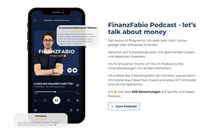
It is worth noting that the finfluencer with the widest reach in German-speaking Switzerland, Fabio Marchesin, alias Finanzfabio, works with simple, consistently repeated formats. The content is deliberately low threshold, strongly focused on everyday questions, comprehensibility and recognisability. His best-known format is his podcast, to which experts and well-known representatives from the financial sector are invited.
The strong presence of women among the relevant finfluencers, such as Angela Mygind (Miss Finance) and Helga Bächler (Liebe Finanzen), is noteworthy. They are particularly well represented in the areas of pension provision, financial planning and everyday finances. Many of these profiles focus on community proximity, personal experiences and real-life issues – and thus reach women of all ages and walks of life.
How do finfluencers earn their money?
Influencers pursue different business models, which vary depending on their reach, positioning and platform. Paid collaborations with financial institutions or providers of financial products are common. Other sources of income include affiliate models (e.g. via financial blogs), own products such as online courses, books or membership offer, sponsored podcast and event formats, as well as media appearances and speaking engagements.
The financial incentive is constantly motivating new financial and investment experts to jump on the finfluencer bandwagon. Younger personalities who have their peers in their sights, as well as "best agers" who use their social media profiles to share their experience and expertise with new audiences on "ageing" channels such as Facebook or Instagram.
Credibility as the key currency
For finfluencers, however, credibility is the key to success. It does not come from reach alone, but from consistency, transparency and long-term leadership on specific topics. Collaborations are a big part of their business model, and as the number of collaborations increases, so does the risk of diluting their own brand.
Profiles that clearly label advertising, enter into collaborations selectively and maintain their content line over a longer period of time enjoy significantly more trust. This credibility is particularly important in the financial sector, where misguided incentives and conflicts of interest are viewed with particular scepticism.
For collaborations between financial institutions and finfluencers, this means that not every high reach and presence, even outside of social media, is automatically relevant. The decisive factor is whether a profile is compatible with the institution's own values and goals, regulatory requirements and desired tone. In addition, collaborating with a finfluencer also means correctly assessing the reputational risk.
Financial education platforms as an alternative
Alongside individuals, financial education platforms and thematic communities are gaining in importance. They are less personalised, invest more heavily in editorial structures and position themselves explicitly as knowledge providers.
Such platforms offer interesting alternatives for companies and organisations: guest contributions, co-creation formats or content partnerships enable a deeper engagement with topics without being tied to a single person.
And not every collaboration has to be influencer driven. Especially when it comes to more complex financial topics, such platforms can effectively bridge the gap between specialist knowledge and understandable communication.
Strategic clarity over short-term reach
Finfluencers play a relevant role in the Swiss financial market – especially in the areas of financial education, initial access to investing and pension topics. However, their impact is not automatic, but rather the result of a combination of credibility, thematic relevance and objectives.
Successful collaboration with finfluencers is less a question of budget or short-term success and more a matter of strategic positioning. The decisive factor is not who is the most influential or has the widest reach, but rather which form of collaboration fits best with your own long-term positioning.
Another blog on the topic: Embracing the Finfluencer Era