IRF Publishes ESG Monitor Switzerland 2026: ESG Reporting Among Swiss Blue-Chip Companies Reaches a New Level of Maturity
A new study by IRF, a leading Swiss strategic communications consultancy, shows that sustainability reporting among Switzerland’s largest listed companies has entered a new phase of maturity. After years of adapting to new regulatory requirements, companies are now placing greater emphasis on reporting quality, reliable data and the implementation of sustainability strategies. At the same time, voluntary international reporting standards continue to play a central role in corporate reporting, with companies increasingly focusing on those frameworks that are most relevant to their business, stakeholders and regulatory requirements.
Voluntary reporting standards and initiatives continue to play a central role in sustainability reporting, even in an increasingly regulated environment. They provide companies with a structured framework for setting sustainability targets, defining priorities, and measuring and communicating progress in a transparent manner.
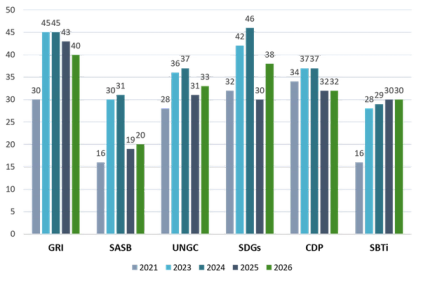
For the 2025 reporting year, all 47 companies included in the SMI Expanded published either a standalone sustainability report or a comprehensive sustainability section within their annual report. All companies apply at least one of the six international ESG reporting standards and initiatives analysed, while around 70% use four or more. At the same time, the consolidation observed in the previous year continues. Whereas 20 companies applied all six standards in 2024, only nine do so in 2026.
The most common voluntary standards and their prevalence in the SMI Expanded
The Global Reporting Initiative (GRI) remains by far the most widely adopted reporting framework, with 40 out of 47 companies (85%) reporting in accordance with or with reference to the GRI Standards. Following last year’s decline, the application of the SASB Standards has stabilised at 20 companies (40%). The UN Global Compact (UNGC) continues to be widely adopted, with 33 companies (64%) participating. The most notable development can be seen in the Sustainable Development Goals (SDGs): after a significant decline in 2025, 38 companies (81%) once again integrate the SDGs into their sustainability reporting. Participation in the Carbon Disclosure Project (CDP) also remains stable at a high level, with 32 companies (68%) reporting through the platform.
The Science Based Targets initiative (SBTi) continues to gain momentum. 30 of the 47 companies (64%) are now listed in the SBTi database. Of these, 27 have already established science-based emissions reduction targets that have been officially validated, while a further three companies are currently developing their targets. This confirms the ongoing shift towards measurable and scientifically robust climate commitments.
Integrated reporting and external assurance continue to gain ground
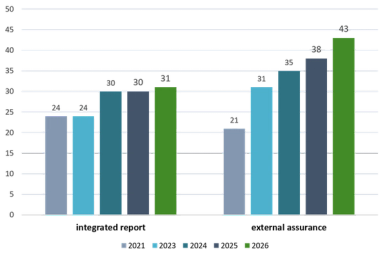
Sustainability reporting is becoming an increasingly integral part of corporate reporting. 31 of the 47 companies (66%) now integrate sustainability information into their annual report. This continues a long-term trend: while 24 companies adopted integrated reporting in both 2021 and 2023, the figure increased to 30 in 2024 and 2025. Sustainability is therefore becoming increasingly embedded within companies' overall financial and strategic reporting.
External assurance of sustainability information is also becoming more widespread. More than 90% of companies now obtain independent assurance for all or part of their sustainability reporting, strengthening the credibility of disclosures and increasing confidence among investors, regulators and other stakeholders.
Regulatory landscape continues to evolve
After several years in which sustainability reporting was primarily driven by new regulatory requirements, the focus is now shifting towards implementation. With its Omnibus Package, the European Union is responding to concerns over the complexity of the Corporate Sustainability Reporting Directive (CSRD) and the European Sustainability Reporting Standards (ESRS) by proposing simplifications and postponements for selected requirements.
Switzerland is also continuing to develop its ESG regulatory framework. Under the proposed Federal Act on Sustainable Corporate Governance (NUFG), sustainability reporting and corporate due diligence requirements will be consolidated into a single piece of legislation while remaining closely aligned with developments in European regulation. The study nevertheless shows that sustainability remains a strategic priority despite a changing regulatory landscape. Today's challenges lie less in establishing additional reporting structures than in implementing sustainability strategies and providing robust, reliable and externally verifiable sustainability information.
Method
The ESG Reporting Monitor Switzerland 2026 is based on IRF’s sixth comprehensive analysis of sustainability reporting by listed Swiss companies. The study examined the sustainability reports published by the 47 companies included in the SMI Expanded for the 2025 financial year that were available as of 31 May 2026. For one company, the 2024 sustainability report was included, as its 2025 report had not yet been published by the cut-off date.
The analysis focused on the sections describing each company’s reporting approach. The findings were cross-checked against the online databases of the respective reporting standards and initiatives. The study assessed the application of the six most widely used voluntary ESG reporting frameworks and initiatives, as well as the reporting format adopted by each company. The findings were compared with the studies published in 2025, 2024, 2023 and 2021.
About IRF
IRF is a leading Swiss consulting firm for strategic communication. The company counts around 40 Swiss and international companies among its retained clients. In addition, IRF has made a name for itself in crisis communication and in accompanying capital market transactions.