Two-thirds of CEOs at Switzerland's 100 largest companies actively use LinkedIn
The new LinkedIn CEO study 2025 by IRF shows that 66% of CEOs of the 100 largest Swiss companies communicate more or less regularly, while one third refrain from self-directed digital visibility. CEOs who address clear topics, post regularly and contribute personal perspectives are particularly successful.
How visible are Swiss business leaders on LinkedIn and what are their main focuses there? IRF's study on CEO positioning on LinkedIn is the first systematic analysis of the profiles and posts of CEOs of the 100 largest listed Swiss companies.
The study includes quantitative and qualitative evaluations of over 1,700 posts and a thematic weighting across ten categories, from strategy, innovation and ESG to employer branding and thought leadership. This has resulted in a benchmark for the digital positioning of Swiss CEOs. It shows how top managers differ in their personal profiles and what successful profiles have in common. The result: two-thirds of CEOs are active on LinkedIn and use the platform to position themselves and their companies.
Key findings of the study
- 66% of CEOs are active on LinkedIn, while 34% have no profile or only an inactive one.
- Over 1,700 posts from the last twelve months were evaluated and assigned to ten topic categories.
- The 25 most active CEOs publish around 70% of all posts.
- Top performers achieve engagement rates of over 2%, which is a peak value compared to company profiles.
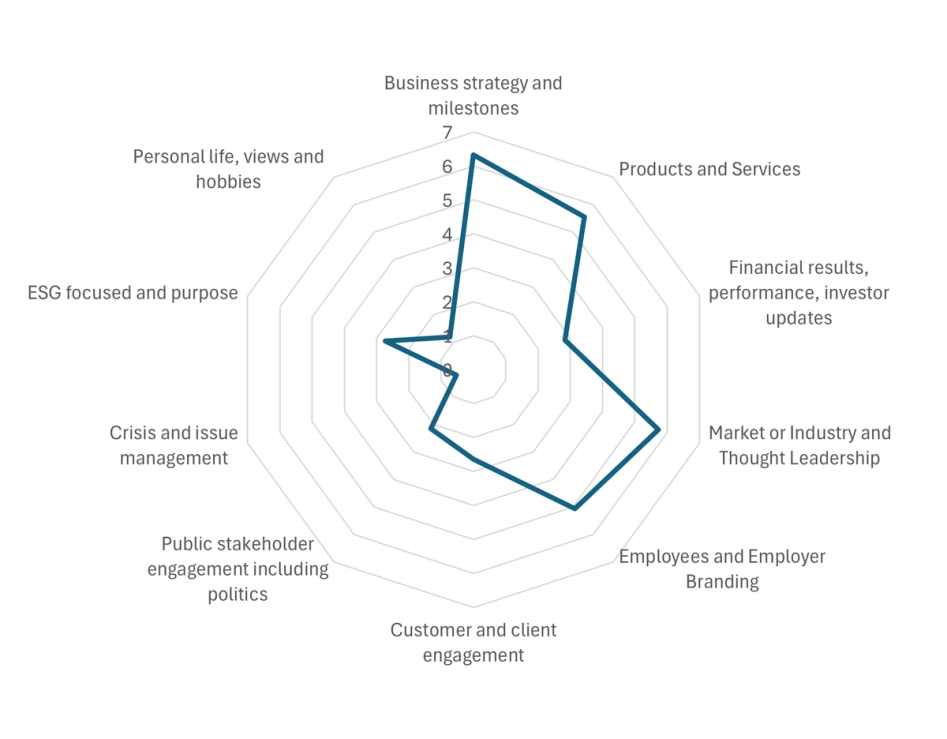
- The main topics covered are strategy & milestones, products & innovation, thought leadership, and employees & employer branding.
- CEOs with a clear thematic positioning achieve significantly higher interaction rates than those with a broad, unspecific range of topics.
Surprisingly, one third of all CEOs do not have a reasonable presence on LinkedIn. Simone Frei, consultant at IRF:
"The reach of traditional media is declining. In contrast, the importance of social media is steadily increasing. LinkedIn has established itself as the central platform for business topics. CEOs have a clearly better response here than company profiles. This makes appropriate communication on LinkedIn a must for CEOs, who play a special role in the external image of a company."
It is noteworthy that 24 of the inactive CEO profiles have a combined total of over 62,000 followers, even though they published no or only one or two posts per year. This illustrates the interest in the CEO as a person and at the same time shows how much reach and potential impact remains untapped.
The middle group of the 20 most active CEOs published around 50 posts over a twelve-month period, while the top 5 CEOs published significantly more. An analysis of the content reveals a clear focus:
- Strategy and milestones come first, often in connection with growth, innovation or transformation.
- Products & innovation and thought leadership follow closely behind.
- Posts about employees, corporate culture and employer branding are also strongly represented, especially among CEOs who want to demonstrate approachable leadership.
- As expected, financial communication, such as annual or quarterly results, plays an important role for the target group of investors and shareholders in listed companies, but is more likely to be linked to a strategic or cultural context.
Topics such as sustainability (ESG) or the involvement of public interest groups are less common but remain part of holistic CEO communication.
The resulting benchmark chart from the study visualises this weighting and shows which topics shape CEO communication in Switzerland and where there is still potential.
The analysis of the response clearly shows that relevance beats reach. CEOs who regularly talk about a few strategically chosen topics and contribute personal perspectives generate greater resonance and trust. Irregular posting behaviour or simply reposting company contributions, on the other hand, remains largely ineffective.
"CEO communication on LinkedIn is not an add-on, but an integral part of leadership and corporate communication," says Simone Frei, consultant at IRF and author of the study. "It contributes directly to the perception of leadership, corporate culture and credibility, both internally and externally."
About IRF
IRF is a leading Swiss consultancy specialising in strategic communications, public relations and public affairs. IRF uses its in-depth expertise to support companies, institutions and leaders in challenging situations such as crises, change processes or in positioning themselves in the public eye. The consultancy services range from media relations and reputation management to supporting political processes. With a multidisciplinary team and a network of experienced consultants, IRF offers customised solutions for the demands of a dynamic and networked world.
Contact: Simone Frei, Consultant, frei@irf-reputation.ch, Tel. +41 43 244 81 43
The complete study in German is available for download here.