«Right in the middle, not merely on the sidelines» – transformation of Investor Relations
Investor Relations (IR) is a comparatively young professional field, but one that has experienced rapid development in recent years. In times of increasing regulatory requirements, faster communication channels and changes in shareholder structures, Investor Relations Officers (IROs) are taking on an increasingly critical role in companies. How far has the professionalization of this field progressed and what developments are currently affecting IROs in particular? A review of the current state of scientific research and insights from Michel Gerber, Head Investor Relations & Sustainability at VAT and Honorary President of the IR club, reveal what makes the IR profession tick today.
The growth dynamics of investor relations
The professional field of investor relations has experienced continuous growth in recent years, both in terms of quality and quantity. This growth is accompanied by a progressive professionalization of the profession. Nevertheless, there are still no uniform entry routes, requirement profiles, self- or external perceptions in this field. This enormously complicates the institutionalization of the profession.
However, further institutionalization and professionalization are crucial to strengthening the internal positioning of the IR department in companies, recruiting qualified young talent and ensuring the functionality of this increasingly mission-critical function.
Research on IROs and their professional profiles has also been patchy: Roles that IROs perform in their daily work have received little attention. However, research on IR roles offers the professional field the opportunity for self-reflection, and also for revealing both individual and collective development potential. It thus contributes to the professionalization and institutionalization of the field.
The Path to Institutionalization: The Investor Relations Officer Roles Grid
In order to at least partially close this research gap and to answer the question of how a role model can be derived from the activities and tasks of IROs, IROs were specifically studied in a comprehensive study in cooperation with the German Investor Relations Association (DIRK). The Investor Relations Officer Roles Grid developed on the basis of this data maps the institutionalized roles of IROs in the German-speaking professional field: it divides the profession into four main types of roles based on the dimensions strategic/operational and communicative/financial. A total of eight different roles were identified that IROs can assume depending on their needs and competencies.
The eight roles of Investor Relations Officers
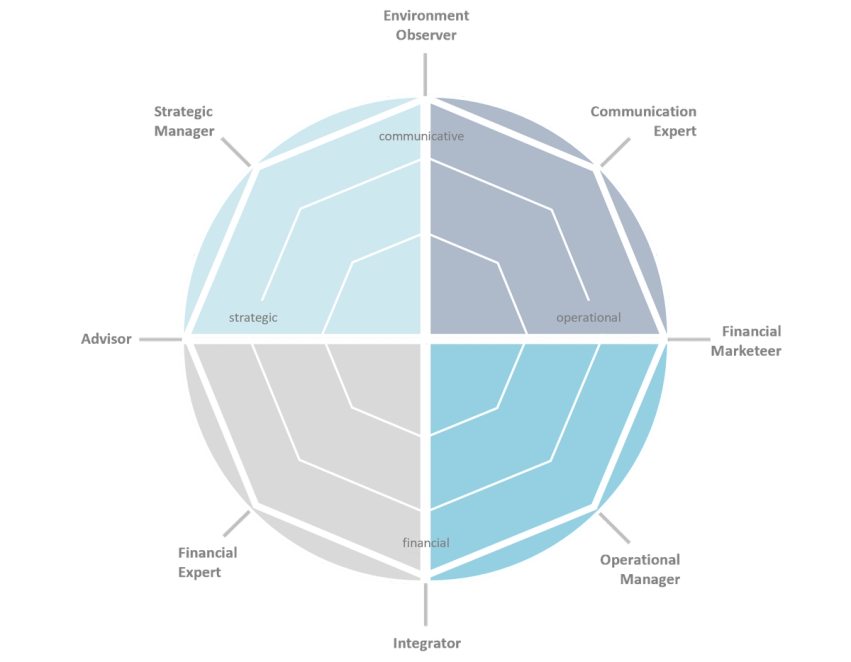
Communication Expert: This operational, communicative role involves dialogic communication with stakeholders as well as the translation of strategic decisions into communicative measures. The key qualifications for this are of a communicative nature, as this role is located on the communicative side of the model.
Financial Marketeer: The role of the Financial Marketeer focuses on disseminating strategic corporate decisions through various channels as easy-to-understand messages. The goal is to increase the share price and ensure a good corporate reputation.
Operational Manager: The Operational Manager performs operational management activities within the IR department and requires an understanding of financial topics and valuation models. Duties include the preparation of the annual report and the organization of roadshows.
Integrator: This role coordinates the cooperation between the IR department and other departments in the company. It ensures that all departments understand and fulfill their responsibilities with regard to IR. An IRO as Integrator contributes to the institutional independence of the IR department.
Financial Expert: The Financial Expert is a strategic, finance-related role. This person maintains close relationships with analysts and investors to meet their information needs. A deep understanding of the capital market is critical here.
Advisor: In the role of an Advisor, an IRO advises top management on potential risks and strategic decisions from a capital market perspective. The advice is provided both from a communications perspective and with regard to the requirements of the capital market.
Strategic Manager: The Strategic Manager is responsible for the strategic management of the IR department and plans IR activities and strategies. This role requires knowledge of management concepts and leadership skills.
Environment Observer: The Environment Observer role involves monitoring competition and other capital market actors and analyzing environmental changes. An IRO as Environment Observer helps to integrate innovative technologies into IR practice.
«From conduit to career opportunity» – IR in practice
A role model is only decisive for the professionalization of the field if it adequately reflects practice. According to Michel Gerber, Head Investor Relations & Sustainability at VAT and Honorary President of the IR club, the scientifically derived roles can be found in today's professional field. However, individual role fulfillment changes over the course of a career: "You first have to grow into a role like that of Advisor. A Communication Expert, on the other hand, an IRO has to be from the very beginning." The more advanced an IRO's career, the more he or she becomes an advisor to both senior management and, at times, the Board of Directors. In order to be able to provide advice to internal stakeholders, monitoring the internal and external corporate environment, as the Environment Observer does, is essential. This is a task that younger IROs can also perform and thus train in the course of their careers, says Michel Gerber.
"The role of IROs is one of the most exhilarating positions in a company – right in the middle, not merely on the sidelines."
Michel Gerber, Head Investor Relations & Sustainability at VAT and Honorary President of the IR club
The role of the Financial Expert is becoming increasingly important: "Today, the financial community has more sophisticated needs than in the past. IROs therefore need to know the entire company in depth in order to be able to provide analysts and investors with the appropriate answers." In addition, to optimize the flow of information, IROs' work as Integrators is central. An extensive network within the company provides IROs with the necessary insights that can be delivered to the network outside the company in a targeted manner. " Right in the middle, not merely on the sidelines," is Michel Gerber's conclusion on the IR profession: Due to the versatile job profile, IROs are typically intertwined with a variety of internal and external stakeholders and are thus an indispensable part of various processes and corporate activities.
Overall, the professional field has developed strongly in recent years, says Michel Gerber. Not least the Covid pandemic has changed the modus operandi: The acceptance of virtual formats has increased, audiovisual content is more valued, and ESG topics such as sustainability reporting and corresponding regulations have come into focus. This places additional demands on IROs: "The IR profession has evolved from a conduit to a career opportunity," summarizes Michel Gerber. Specialization within the profession will continue to increase in the future due to the increased demands, so that IROs will rarely have to perform all manifestations of the role model. Depending on company-specific needs, IROs will be recruited with a particular educational or experience background, resulting in increasingly diverse teams. In addition, experts will increasingly be consulted on a targeted basis as and when required. This will enable the IR team as a whole to cover all necessary roles at all times.
License to operate through successful IR
In summary, the professional field of investor relations is more diverse and significant today than ever before, and the various roles of IROs contribute significantly to its success. The further development and institutionalization of this professional field are crucial for companies to maintain their "license to operate" and meet the needs of capital market stakeholders.